Skip to Main Content

All gifts to EPSS, help the Department maintain and strengthen its international reputation for excellence, as well as its impact in the community.

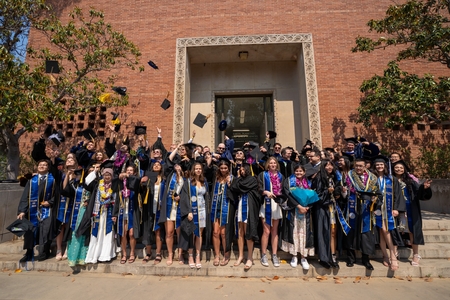
Welcome to the Department of Earth, Planetary, and Space Sciences at UCLA. Our mission is to understand and protect our home in the universe through discovery, education, and outreach. To further this mission we strive to foster an inclusive culture of respect, collaboration, and openness to new ideas and methodologies.

Seminars Today

TimeTitle
3:30 PMSpace Weather as National Infrastructure Risk: Strategy, Science, and Power-Grid Resilience
Description

Location: 3853 Slichter Hall

Presented By:
Antti Pulkkinen   -JPL

Abstract:

Space weather is the “weather” of the space environment driven by our active Sun—solar eruptions and changing solar wind conditions that can disturb Earth’s magnetic field and upper atmosphere, disrupt satellites and communications, degrade navigation and timing, increase radiation risk to astronauts, and induce electrical currents in long conductors on the ground. Over the past decade, U.S. preparedness for major space weather events has changed in two consequential ways: (1) the power sector began translating scientific risk into enforceable reliability practice when the Federal Energy Regulatory Commission (FERC) directed the North American Electric Reliability Corporation (NERC) to develop Reliability Standards to mitigate geomagnetic disturbance (GMD) impacts on the Bulk-Power System ; and (2) the United States adopted a coordinated, whole-of-government posture through the National Space Weather Strategy and Action Plan—now further advanced through a more recent federal implementation plan that builds on the 2015 foundation .

I will highlight key scientific and operational developments from the last few years, including NASA’s Space Weather Program role in advancing space weather observations, models, and applications that support prediction and tracking across the solar system. A central case study will be the May 2024 geomagnetic storm—first G5 (“severe”) storm in over two decades—now commonly referred to as the “Gannon storm,” and what it revealed about magnetosphere–ionosphere coupling, satellite impacts, and the pathways to societal consequences.

Finally, I will offer focused perspectives on high-impact risk areas—especially electric power grids—connecting space physics to practical resilience: where the key areas of uncertainty are, what “good enough” information looks like for operations, and how research, standards, and planning can converge to reduce national risk before the next extreme event.